A puddle beside the water heater feels like bad news, but in a Central Ohio basement or utility room the heater is only one possible source. Furnaces and air conditioners drain condensate, dehumidifiers and water softeners send water to a drain, and floor drains can back up. This guide answers one narrow question: is the water coming from the heater at all? If it is, our guide to a leaking water heater covers how to shut the heater down and pin down the exact spot.
Safety first. Do not step into standing water to reach an electrical panel, outlet or appliance cord. Switch off a breaker only from a dry floor. If you smell gas, leave the house and call the gas utility or 911 from outside. Every check here is visual; none requires opening a panel on any appliance.
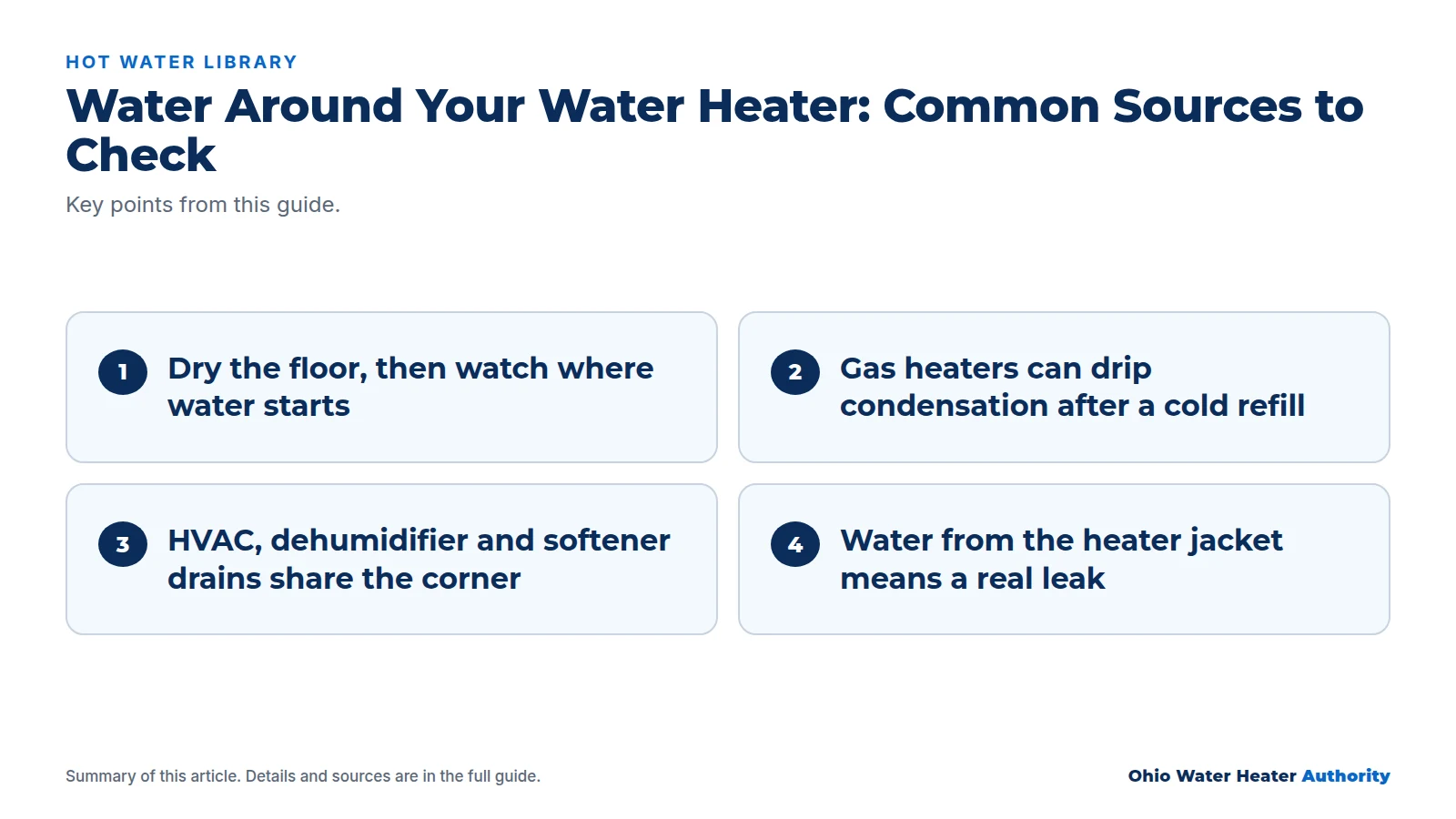
Why the water heater gets blamed for its neighbors
Water heaters, furnaces, softeners and dehumidifiers tend to share one corner of the basement, because each needs a drain, a water line or a vent nearby. Bradford White’s gas water heater manual asks for a location where a leak will not damage the surrounding area, and where that cannot be avoided, a drain pan piped to an adequate drain. In practice that pulls the heater toward the floor drain, and the other equipment often drains to the same spot.
Water from anywhere in that corner collects around the heater base, even when the heater is dry. Where water pools tells you very little. Where it starts tells you almost everything.
The dry-floor test: find where the water starts
All you need is towels, a flashlight and a few hours. Remove the old water, then catch the new water where it first appears.
Dry everything
Towel the floor, the heater base and the floor around the furnace, softener, dehumidifier and floor drain.
Set dry markers
Lay a ring of dry paper towels around the heater base and a few more at each neighbor: under the furnace drain line, below any condensate pump, around the softener and at the floor drain grate.
Note what is running
Write down whether the heat, air conditioning or dehumidifier is running, whether anyone just showered or ran laundry, and when the softener regenerates.
Look up, then look down
Shine a flashlight along the pipes above the heater. Drops that form on the outside of a cold pipe and fall are a different problem from water leaving the tank. If water is collecting on top of the heater, our guide to leaks at the top of the tank sorts out the fittings, T&P relief valve and anode port.
Check twice
Look after an hour, then again after several hours. The first towel to get wet points to the source.
Common sources, side by side
| Source | Where water shows up first | When it tends to appear | What separates it from the heater |
|---|---|---|---|
| Cold-start condensation (gas heater) | Drips inside the burner area, sometimes with a sizzle | After the tank refills with cold water or after heavy hot water use | Stops once the tank is fully heated |
| Sweating cold water pipes | Drops falling from pipes overhead | Humid weather | Beads of water form on the outside of the pipe; the tank jacket is dry |
| Air conditioner, heat pump or furnace condensate | Base of the furnace or air handler, along its plastic drain line | While the system runs | Water traces back to the HVAC cabinet or its drain line |
| Dehumidifier | At the unit or where its hose ends | While it runs | A hose slipped from the drain or a full bucket |
| Water softener | At the floor drain or standpipe it discharges to | During regeneration | Splash marks at the drain and a wet discharge hose |
| Floor drain backup | Up through the drain grate | After heavy rain or a large drain load | Water rises from the drain instead of flowing toward it |
| The water heater itself | On the heater jacket, fittings or base | Any time, and it keeps coming | Continues with other equipment off and the tank hot |
Cold-start condensation: wet heater, no leak
Burning gas makes water vapor. When the tank is full of cold water, that vapor meets the cold flue and tank surfaces and turns back into liquid. A. O. Smith’s technical bulletin on condensation says a typical home water heater produces about one-half gallon of water vapor for every hour it runs, and that condensation should stop once the whole tank is heated above roughly 115°F. Bradford White’s manual describes the same drips falling on the burner with a sizzling sound and states that condensation is normal and does not indicate a leak.
The same bulletin points to low incoming water temperature as the trigger and notes that newer, more efficient heaters condense more than older ones. That is why a new heater, a big bath night or cold winter supply water can bring on a small puddle. To check, dry the area and go easy on hot water for a few hours so the tank can heat all the way through. If the floor stays dry once the tank is hot, it was condensation. Leave the gas control alone; you do not need to adjust it to run this check.
Electric tanks are different. A. O. Smith notes that the insulation around an electric tank usually keeps any surface condensation out of sight. Steady water at the base of an electric heater is less likely to be condensation and deserves a closer look.
Sweating pipes overhead
In humid weather, cold water pipes collect condensation on the outside. Bradford White tells installers not to run cold water pipes directly above the gas control so that this condensate does not drip onto it. Beads on the outside of the cold line with drops landing beside the heater mean the pipe is the source. Pipe insulation or a dehumidifier is the usual fix.

Air conditioner, heat pump and furnace drains
Central air conditioners and heat pumps pull moisture out of the air while they cool, and that water leaves through a condensate drain, usually a small plastic line running to a floor drain or to a condensate pump. ENERGY STAR’s heating and cooling maintenance checklist tells homeowners to have the condensate drain in a central air conditioner, furnace or heat pump inspected, and warns that a plugged drain can cause water damage in the house.
- Follow the plastic drain line from the furnace or air handler. Water along it points to the drain, not the heater.
- Check any condensate pump, a small box with a tube leaving the top. A stopped pump or a loose tube overflows onto the floor.
- If the water stops when the system is off and returns when it runs, the HVAC equipment is your source. That is a heating and cooling repair, not a water heater repair.
One exception sits on the water heater side. Hybrid heat pump and condensing tankless heaters make condensate by design and drain it through their own line, so a clogged one can wet the floor while the heater is sound.
Dehumidifiers and water softeners
Both appliances send water to a drain, so both can miss. A dehumidifier hose that has pulled out of the drain, a kink that backs water up, or an overfull bucket can each leave a puddle that looks like it belongs to the heater.
A water softener discharges rinse water when it regenerates. A cross-connection brochure from Marshfield Utilities notes that this water flows fast rather than dribbling out, and that the discharge should end with an air gap above a floor drain, standpipe or laundry sink. If the drain cover is not opened up enough, the discharge can splash across the floor. Check the regeneration time on the softener control, then look at the drain and the discharge hose after that time. Look around the base of the brine tank as well.
Floor drains and the slab
A backed-up floor drain puts water on the floor from below. It rises at the grate first, often after heavy rain or when several fixtures drain at once, and it points to a drain line problem. Water that appears at the joint where the wall meets the floor, or along a crack after rain, points to groundwater, and that belongs with a drainage or waterproofing contractor.
When the water heater is the source
If the towels at the heater are the first to get wet, water keeps coming after the tank is hot, and the other equipment is off, the heater is the source. Close the cold supply valve and follow the shutdown steps in our leaking water heater guide, which also explains how to tell a fitting or valve from the tank. Fittings and valves are usually a water heater repair. A tank that has corroded through cannot be sealed, and replacement is the only fix. Our diagnostic visit is free.
Two additions make the next episode easier to diagnose. A drain pan piped to a drain keeps heater water in one place, so a wet pan points straight at the heater. A sensor with an automatic shutoff valve, covered in our guide to leak protection, alerts you when water reaches the base and closes the supply.
What to do next
If the dry-floor test points to the water heater, or you still cannot tell where the water starts after a day of watching, check availability for a diagnostic visit or call 844-792-8374. Tell us which towels got wet first; it helps the technician start in the right place.

Common questions
Is it normal for a gas water heater to drip water when it first heats up?
Yes, within limits. Burning gas makes water vapor, and it condenses on a tank full of cold water, then drips onto the burner with a sizzle. Manufacturers describe this as normal. It should stop once the tank is fully heated, so water that keeps coming after that is worth a closer look.
Can my furnace or air conditioner cause water around the water heater?
Yes. Air conditioners, heat pumps and many furnaces drain condensate through a small plastic line or a condensate pump, often to the same floor drain the water heater sits beside. A clogged line or a failed pump will overflow, and the water runs to the low point near the heater. If the water stops when the system is off, the HVAC equipment is the source.
Why is there water around my water heater after it rains?
Rain points away from the heater. A floor drain can back up during heavy rain, and groundwater can seep in at the wall-floor joint or through cracks. The heater has no connection to either, so the fix is a drain line or drainage repair.
Can a water softener put water on the floor near my water heater?
It can. A softener discharges rinse water quickly when it regenerates, usually into a floor drain or standpipe through an air gap. If the hose moves or the drain cover blocks the flow, water splashes onto the floor. Check the drain and hose right after the scheduled regeneration time.
How can I tell if the water heater tank itself is leaking?
Water that keeps appearing on the heater jacket or at its base after the tank is hot, with the other equipment off, points to the heater. Seepage from under the jacket, with no wet fitting above it, usually means the tank has corroded through. A tank leak cannot be repaired, so the heater needs to be replaced.
Should I turn off my water heater if I find water around it?
Only if the water is coming from the heater or you cannot rule it out. In that case close the cold water supply valve and turn the heater off at its gas control or breaker, reaching the breaker only from a dry floor. If the water clearly comes from another appliance, the heater can stay on.