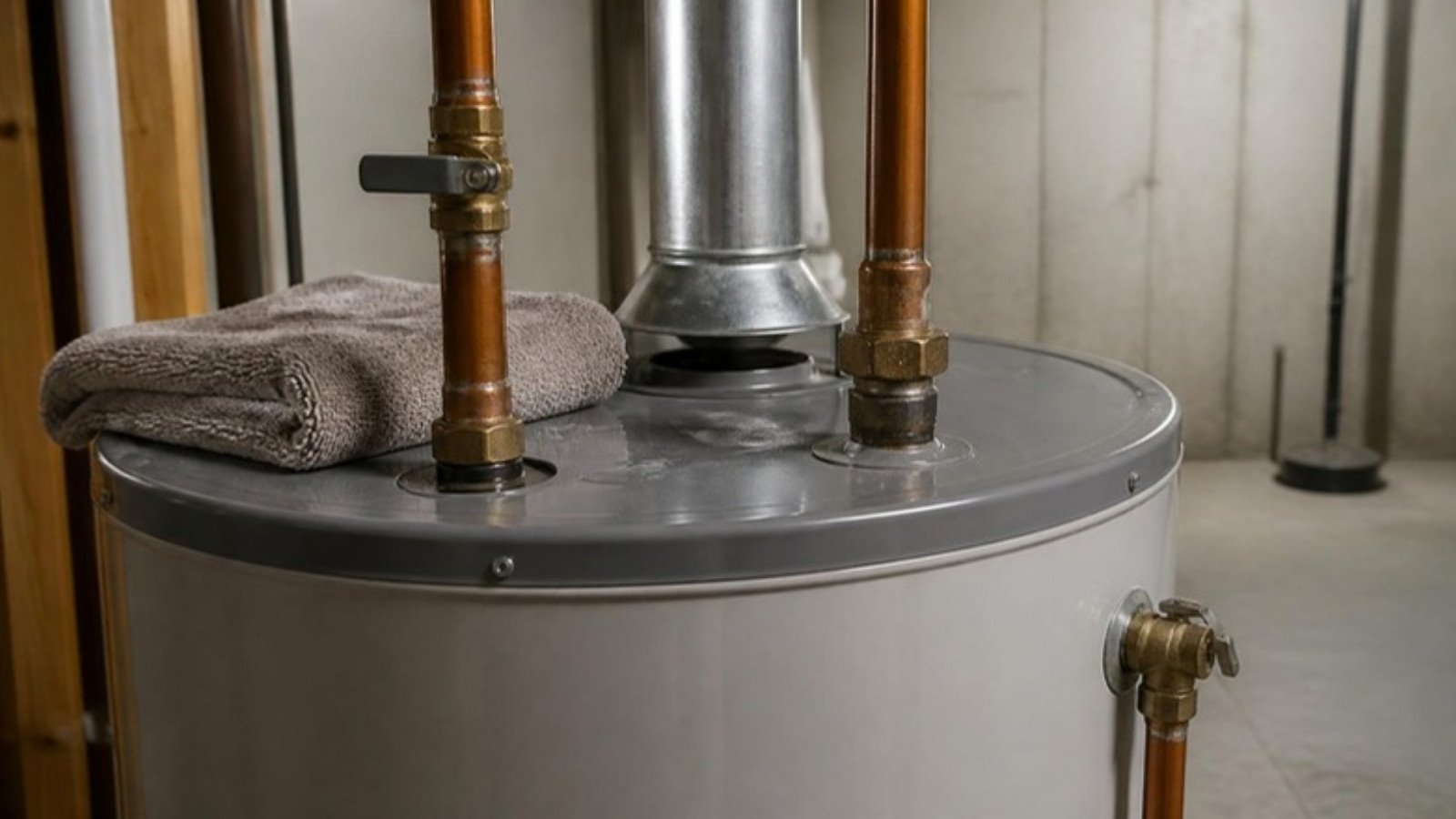
Water on top of a water heater looks alarming, but the top is where most of its connections live, and connections can be fixed. The cold inlet, hot outlet, relief valve and, on many models, the anode rod all pass through the top or upper side of the tank. This guide covers only leaks that start there. For the full first-five-minutes routine and leaks lower on the heater, start with our general guide to a leaking water heater.
Why a leak at the top is usually a repair
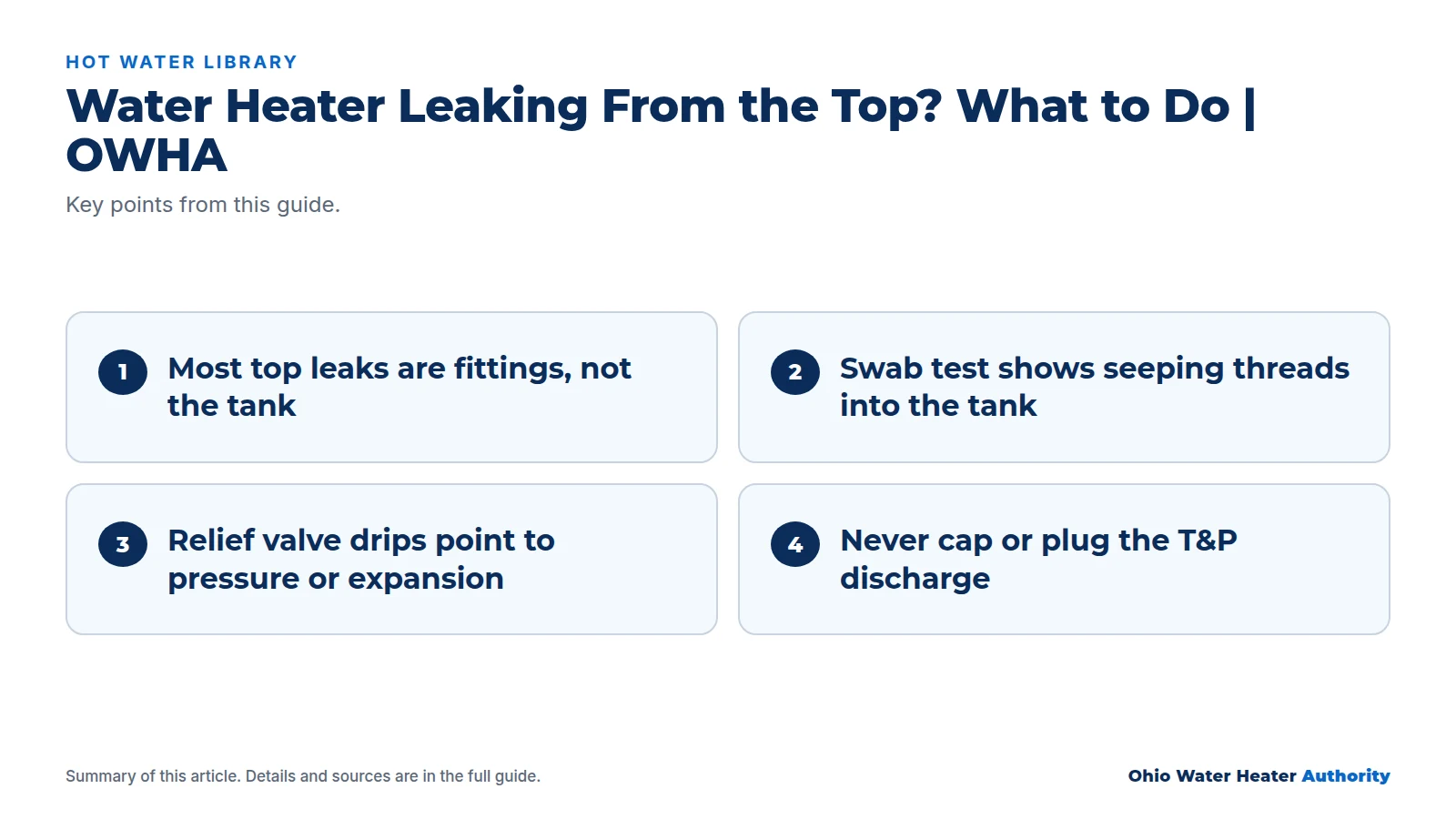
A tank heater is a steel vessel inside insulation and a thin jacket, with threaded fittings screwed into its openings. Water at the top most often comes from a joint: a pipe connection, a threaded fitting or a valve. Joints can be resealed or replaced. A. O. Smith’s electric heater manual notes that almost all leaks occur at connections, not the tank.
The exception is corrosion of the tank itself. Tanks rely on a sacrificial anode rod to slow rust. A. O. Smith’s power vent manual explains that once the anode is used up, the tank starts to corrode and will eventually leak. On an older heater, water around a top opening can be the first sign.
Map the top of your heater before you touch anything
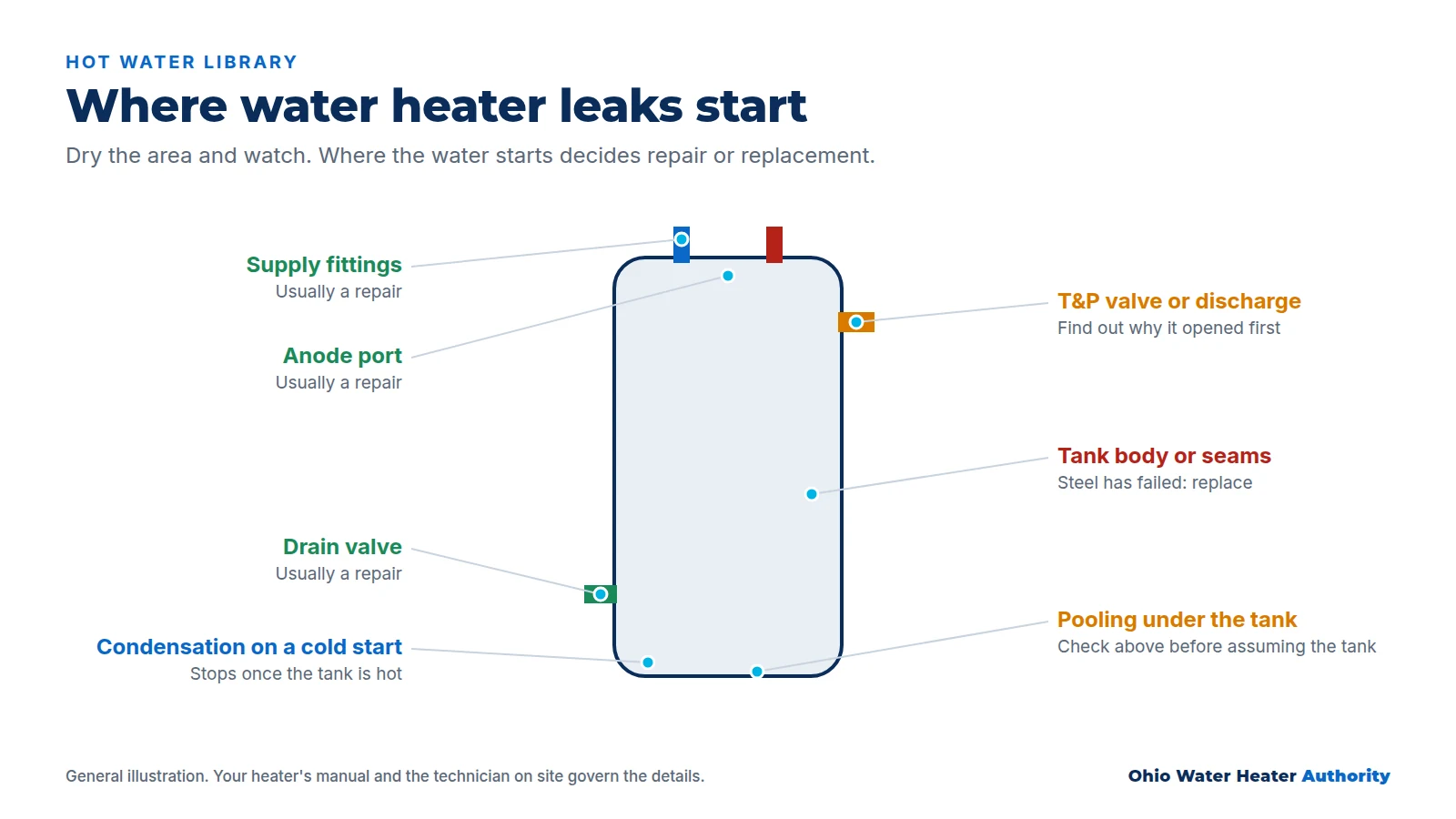
Water follows pipes downhill, so the wet spot you notice is often below the real source. Use this table to name what you see.
| Where the water is | What is usually behind it | Usual outcome |
|---|---|---|
| Pipe joints, valves or flexible connectors above the heater | A loose or corroded connection, or condensation on cold pipes in humid weather | Repair, or no fault if it is condensation |
| Where the hot or cold nipple enters the jacket | The threaded fitting into the tank is seeping | Repair if the tank is sound |
| Coming out of the T&P discharge pipe | The valve is opening, often from high pressure or thermal expansion | Find the cause, then repair |
| Around the threads where the T&P valve enters the tank | The valve fitting is seeping | Repair |
| Around the anode rod’s hex head | The anode fitting is seeping, or corrosion at that opening | Repair, or replace if the tank is corroding |
| At the blower or vent connection of a power vent heater | Condensed combustion vapor from a vent problem | Vent repair by a technician |
Layouts vary. Some heaters carry the relief valve on top, others on the upper side, and the Bradford White atmospheric gas models we reviewed combine the anode with the hot outlet nipple.
Pipe connections and the inlet and outlet nipples
The hot and cold connections sit on top of most tank heaters and are marked H and C. Bradford White’s gas manual describes them as dielectric waterway fittings with a plastic liner, and it warns installers never to apply soldering heat to those nipples. A. O. Smith recommends a dielectric union at these connections because copper pipe can carry small electrical currents that corrode dissimilar metals. Many models also hide heat traps inside the nipples to stop hot water from drifting up the pipes.
A connection that was overheated during soldering or joined metal to metal without a dielectric fitting can corrode and seep. White or green crust and rust staining on the tank top point to a connection.
To tell a pipe joint from a fitting that screws into the tank, A. O. Smith’s leakage checkpoints suggest a simple test: slide a cotton swab into the gap between the jacket opening and the fitting. If the swab comes out wet, the leak is at the threads where the fitting enters the tank. Resealing those threads means draining the heater and removing the fitting, which is a job for a technician. If the swab stays dry and the water is on the pipe above, the leak is in the house piping.
The same checkpoints note that cold pipes sweat in humid weather. Sweat forms evenly along a pipe; a leak starts at one joint and leaves mineral traces.
The T&P relief valve: discharge or a leaking thread
The temperature and pressure relief valve is the heater’s safety device. It opens when tank pressure or temperature climbs too high. Where the water appears tells you what is wrong.
- Water from the discharge pipe outlet. The valve is opening. A. O. Smith links small drips from the discharge pipe to high house pressure or a missing or failed thermal expansion tank. It recommends a pressure-reducing valve set between 50 and 60 psi and states that one is required above 80 psi. Bradford White notes that periodic discharge in a closed system may be thermal expansion. Our guide to water heater expansion tanks explains why closed systems need one.
- Water around the threads where the valve enters the tank. The valve body is fine, but the fitting is seeping. That is a threaded connection like the others, and it is resealed or replaced after the heater is drained.
- A large flow of very hot water. A. O. Smith associates this with a tank that is overheating, for example from a failed thermostat or a shorted element on an electric model. Keep clear of the discharge and call. On an electric heater, switch off its breaker if you can reach the panel from a dry floor.
A. O. Smith adds that a valve which still drips after pressure is corrected may be faulty and need replacing. In current published pricing, a 2-gallon thermal expansion tank starts at $249 installed.
Safety. Never cap, plug or thread the end of the T&P discharge pipe. Both manufacturers warn against it, and a capped valve cannot protect an overheating tank. Water from the valve can be hot enough to scald, so keep hands and faces clear of the outlet. If water is running near the wiring on top of an electric heater, switch off its breaker only if you can reach the panel from a dry floor. If you smell gas at any point, leave the home and call the gas utility or 911 from outside.
The anode port
On heaters with a separate anode, you will see a large hex head or a cap on top of the tank. A. O. Smith’s checkpoints list the anode fitting as a possible leak point, and the cotton swab test works there too.
On a newer heater, a seep at the anode threads is usually a sealing issue corrected when the anode is serviced. On an older heater, a depleted anode leaves the tank unprotected, so heavy corrosion around the opening can mean the tank is already losing metal. Our guide to anode rods covers what they do and how often they are checked.
Water that is not from the plumbing: vents and condensation
Burning gas produces water vapor. Bradford White and A. O. Smith both describe condensate forming on a cold tank and dripping onto the burner with a sizzling sound, most often after a fill with cold water or heavy hot water use. It clears once the tank warms. A. O. Smith puts that at about one to two hours.
Power vent heaters add one more source at the top. A. O. Smith’s checkpoints trace water at the blower assembly to combustion vapor condensing because of a problem in the vent. That is a venting issue, not a tank issue, and it needs a technician to inspect the vent run. Keep hands off the draft hood and vent pipe on any running gas heater; they get hot.
Safe checks you can make before you call
These checks involve looking, drying and closing a valve or breaker, never opening covers, loosening fittings or touching gas controls.
Close the cold supply if the leak is active
The cold shutoff valve is on the pipe entering the top of the heater. If that valve is itself the source, closing it may not stop the water, so use the home’s main shutoff instead.
Dry and watch
Dry the tank top and the pipes above it. Watch for five to ten minutes to see where water returns first.
Use the swab test at each opening
Try the hot and cold nipples, the anode cap and the relief valve threads. A wet swab means the fitting into the tank is seeping.
Check the relief valve outlet
Look for water at the end of the discharge pipe. If it drips only after the heater runs, pressure or thermal expansion is the likely cause.
Photograph and record
Photograph the wet area and the rating plate so the technician can bring the right parts.
Repair or replace: how a top leak decides it
A leak at a pipe joint, a relief valve or a fitting that can be resealed is a repair, and it is worth doing on a heater with life left. Our water heater repair visit starts with a free diagnostic visit.
Replacement makes sense when the source is the tank itself: corrosion around a top opening, or water appearing from under the jacket with no wet fitting. A. O. Smith cautions against replacing a heater until every possible source has been checked, and we follow the same rule. If the tank has failed, water heater replacement explains what an installed replacement includes.
What to do next
If you can see water at the top and are not sure which source it is, call 844-792-8374 or check availability for a diagnostic visit. We schedule visits 7 am to 7 pm, seven days a week, and answer the phone 24/7. Work is performed by appropriately licensed personnel or partners.

Common questions
Is a water heater leaking from the top dangerous?
Usually the risk is water damage, not the tank bursting. It becomes a safety issue when water reaches the wiring on an electric heater or the controls on a gas heater, or when the relief valve releases a lot of very hot water. In those cases shut the heater down and call.
Can I tighten a leaking fitting on top of the water heater myself?
We do not recommend it. The inlet and outlet nipples often have plastic liners and heat traps, and forcing a corroded fitting can make the leak worse. Sealing threads into the tank means draining the heater, which is technician work.
Why does my T&P valve drip only after the heater runs?
Water expands as it heats. In a home with a check valve, backflow preventer or pressure-reducing valve, that expansion has nowhere to go, so pressure rises until the relief valve opens. A correctly sized and pressurized expansion tank usually stops the drip.
Does a leak at the anode rod mean I need a new water heater?
Not always. A seep at the anode threads can be resealed. If the anode is badly depleted and the opening shows heavy rust, the tank may be corroding, and a technician will usually recommend replacement.
Why is there water on top of my gas water heater only in winter?
Colder incoming water makes both condensation and sweating pipes more likely. Condensate that forms after a cold fill clears once the tank warms, which A. O. Smith puts at about one to two hours. Water that keeps returning after that is a leak.
Sources
- Residential Electric Water Heater Installation Instructions and Use & Care Guide
- Signature 500 Power Vent Gas Water Heater Installation Instructions and Use & Care Guide (Leakage Checkpoints)
- Installation and Operation Instruction Manual: Gas-Fired Water Heater with Flammable Vapor Ignition Resistant System
- Ohio Administrative Code Rule 4101:3-5-01, Water heaters