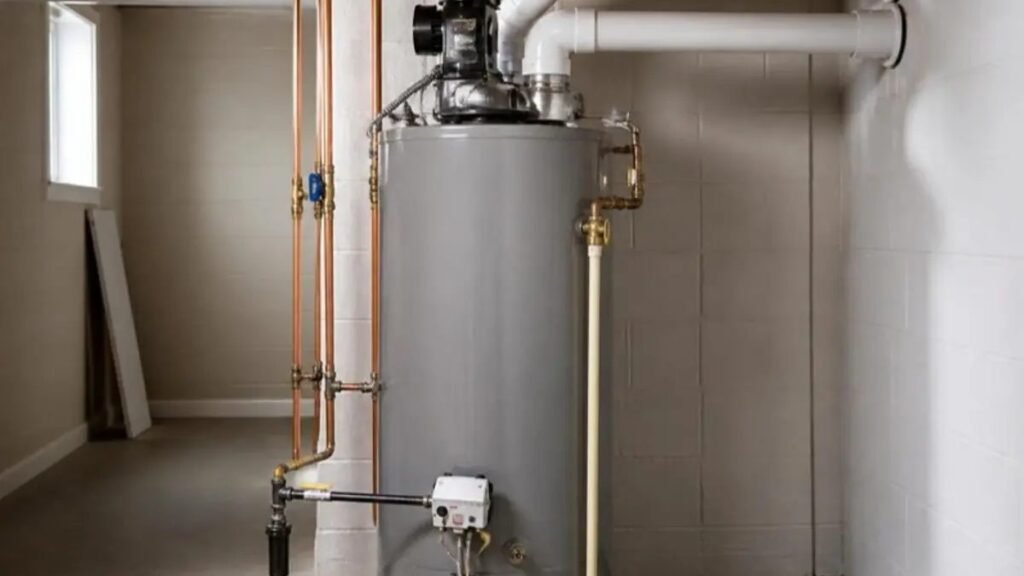
A power vent water heater solves one problem: getting combustion exhaust out of the house when a chimney cannot do it. A small blower on top of the tank pushes the exhaust through plastic pipe to a termination on an outside wall or through the roof. Because the blower does the work, the vent can run horizontally, turn corners and travel farther than a natural-draft flue ever could. That flexibility is why power vent tanks show up in finished basements, newer tight homes and any house where the chimney has been removed or given over to a high-efficiency furnace.
When a power vent is required
- No usable chimney. The chimney was removed, is unlined and deteriorating, or now serves a furnace that vents through PVC and has left the water heater alone in a flue that is too large for it.
- Tight construction. Newer or air-sealed homes can pull air down the flue when dryers, range hoods and bath fans run, which makes natural draft unreliable and can spill flue gas into the basement.
- Basement finish. The heater is moving to a closet or utility room that is not next to the chimney, and the only path out is horizontal through a rim joist.
- Long or awkward flue route. A natural-draft connector that would need to run nearly level or climb through several offsets will not draft well. A blower removes that constraint.
If none of these applies and your chimney is sound, an atmospheric gas tank costs less and has fewer parts. If the heater sits in a garage or a very tight space where indoor combustion air is the issue rather than the exhaust path, a direct vent unit may be the better fit.
What the installed price includes
- The power vent water heater, with the manufacturer tank warranty for the tier: 6, 10 or 12 years.
- New water connections, a new flexible gas connector and sediment trap.
- Connection to existing PVC venting when it is correctly sized and terminated, or reconnection of the vent on a like-for-like replacement.
- Plug-in to an existing 120-volt outlet within reach of the unit.
- A temperature and pressure relief discharge line that terminates correctly.
- The permit, pulled by us and passed through at cost.
- Haul-away and recycling of the old heater.
- Startup testing: fill, purge, gas leak check, gas pressure, blower and pressure switch operation, and a combustion check at the termination.
- A workmanship warranty of 1, 2 or 5 years by tier.
Three tiers for a 50-gallon power vent water heater
Essential
Dependable, code-compliant replacement
Starting at $3,049
- 6-yr tank + 1-yr workmanship warranty
- Heater, standard installation and haul-away
Preferred
Better efficiency and longer protection
Starting at $3,749
- 10-yr tank + 2-yr workmanship warranty
- Heater, standard installation and haul-away
- Thermal expansion tank (2 gal) included
Authority
Premium system plus enhanced protection
Starting at $5,099
- 12-yr tank + 5-yr workmanship warranty
- Heater, standard installation and haul-away
- Thermal expansion tank (2 gal) included
- Drain pan with drain connection included
- Leak sensor with automatic shutoff valve included
- +1 more included
Estimated installed prices for Central Ohio. Your online estimate is based on the installation details you provide. A technician verifies conditions before work begins, and if anything changes the price we show and explain the difference before proceeding.
Starting prices by size
| Size | Essential | Preferred | Authority |
|---|---|---|---|
| 40-gallon | Starting at $2,899 | Starting at $3,599 | Not offered |
| 50-gallon | Starting at $3,049 | Starting at $3,749 | Starting at $5,099 |
Preferred and Authority include a 2-gallon thermal expansion tank. Authority adds a drain pan with drain connection, a leak sensor with automatic shutoff valve and the first year of the annual maintenance plan. Labor-only installation of a customer-supplied power vent unit starts at $1,449.
PVC sidewall venting
Power vent exhaust is cool enough to run in schedule 40 PVC, and most units accept 2, 3 or 4-inch pipe depending on how far it has to go. The manufacturer publishes a maximum equivalent length, with every elbow counted as several feet of straight pipe, and we design the route to stay well inside it. Termination matters as much as length. The outlet must sit a set distance from windows, doors, fresh-air intakes, gas meters and grade, and it must clear snow depth in a Central Ohio winter. Exhaust that lands under a deck or next to a bedroom window is a code problem and a comfort problem. When the vent route changes, new PVC is priced at $299 per 10 feet, and your technician measures the run before confirming the estimated installed price. Verified on site
The 120-volt outlet
The blower, control board and igniter run on ordinary household power through a three-prong cord. The outlet needs to be within reach of the cord, because the manufacturer’s manual rules out an extension cord. Rheem’s residential power vent installation manual requires a grounding receptacle and does not recommend installing the heater on a GFCI circuit. The technician verifies the outlet and circuit before installation. If there is no outlet near the heater, a licensed electrician adds one. Electrical is a separate licensed trade in Ohio, so we coordinate that for $149 and pass the electrician’s price through.
Noise
The blower runs only while the burner runs, and at close range it sounds like a bathroom exhaust fan. In an open basement it is rarely noticed. Under a bedroom or beside a finished room it is audible, so we support the vent pipe properly, avoid long unsupported horizontal runs that hum, and keep the route short. If noise is a concern and the location allows it, a direct vent unit has no blower at all.
Hi, Wattson here. If your furnace got a PVC vent in the last few years and your water heater still uses the chimney, take a look at the flue in winter. Rust streaks or white staining on the chimney connector usually mean the exhaust is cooling and condensing before it gets out. That is your sign to talk about a power vent before the liner fails.
What can change the price
| Condition | Why it matters | Installed price |
|---|---|---|
| New or rerouted PVC vent | New material and a compliant termination when the route changes. Required | $299 per 10 ft |
| No 120-volt outlet within reach | Electrician adds a dedicated receptacle; we coordinate. Required | $149 plus electrician’s price |
| Closed plumbing system without an expansion tank | Code requires one to control pressure spikes. Required | $249, included in Preferred and Authority |
| Gas line rework to reach the new valve | New connector and sediment trap required on replacement. Required | $349 |
| Old chimney flue opening left open | Must be capped or sealed so the basement does not draw outside air down the chimney. Required | Included when converting |
| Heater in a closet or above finished space | A drain pan routes a small leak to a drain. Recommended | $129, included in Authority |
- Included
- Part of the option you chose.
- Required
- This condition must be corrected for the proposed installation to be safe and code-compliant.
- Recommended
- Not required for the heater to operate, but it improves protection or serviceability.
- Optional
- A comfort or protection upgrade. Your choice.
- Requires field verification
- Priced after a technician confirms the condition on site.
Our process
Choose size and tier online
The quote builder shows the starting-at price for a power vent 40 or 50. If you are unsure whether you need one, the find-my-water-heater tool helps you identify what is there now.
Book a two-hour window
Same-day windows in Columbus and the inner suburbs when booked before 1 pm; next-day in the outer ring.
On-site verification
The technician measures the vent route, checks the termination location, outlet, gas piping, water pressure and drain path, and confirms an estimated installed price in writing.
Installation and startup
Drain and remove the old tank, set the new one, run or connect venting, connect gas and water, fill and purge, then fire the unit and verify blower operation, pressure switch and combustion at the termination. You receive photos, serial numbers, the permit record and warranty terms.
Safety and code notes
Work follows the 2024 Ohio Plumbing Code, the Residential Code of Ohio, the Ohio fuel gas provisions and the manufacturer’s installation instructions, which govern vent material, length and termination clearances. Combustion air is still verified even though the exhaust is fan-driven, because a power vent tank draws its burner air from the room. Work is performed by appropriately licensed personnel or partners. Ohio Water Heater Authority is a Transit & Flow™ company, privately owned and not affiliated with the State of Ohio or any utility.
Where we install power vent water heaters
Columbus, Franklin County and the inner suburbs, with same-day windows when booked before 1 pm. Delaware, Powell, New Albany, Marysville, Lancaster, Newark and the rest of the outer ring are next-day. See the service area page.

See your power vent price
Pick 40 or 50 gallons and a tier, see the installed starting price with permit and haul-away included, and book a two-hour window. Or call 844-792-8374, answered 24/7.