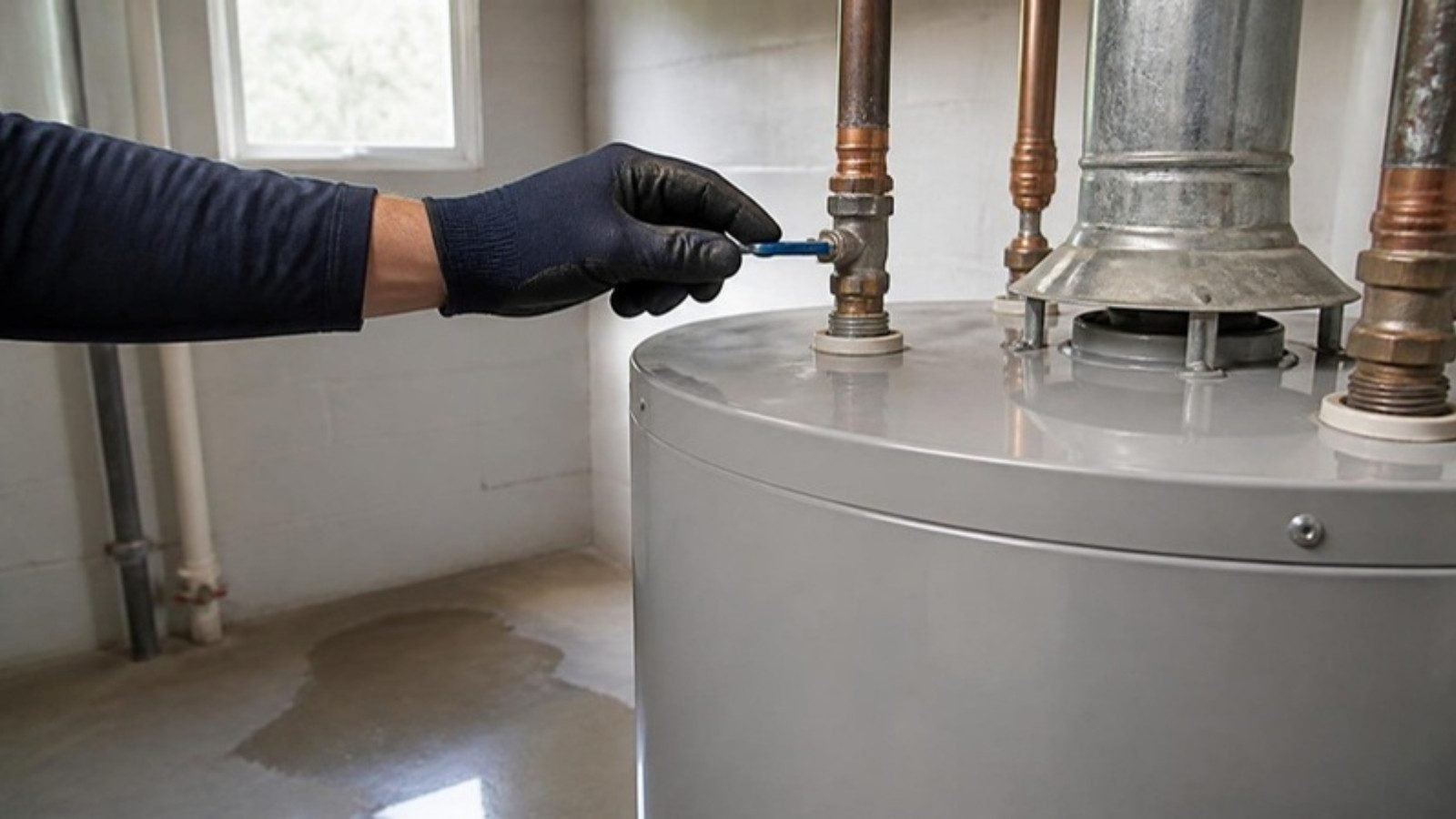
Most water heater leaks are not the tank. A loose fitting, a weeping relief valve or a worn drain valve can each put water on the floor, and each is a repair. The tank itself leaking is different: once the steel has corroded through, nothing seals it, and the heater has to be replaced. This guide shows how to stop the water safely, find where it is coming from, and tell the two apart.
The first five minutes
- Keep clear of standing water near the electrical panel or the heater wiring. Switch off a breaker only if you can reach the panel from a dry floor.
- Close the cold water supply valve on the pipe entering the top of the heater. A lever handle is closed when it sits across the pipe; a round handle closes clockwise.
- Gas heater: turn the control knob to OFF. Electric or hybrid heater: switch off its breaker.
- Open a hot water tap nearby to relieve pressure in the tank.
- Photograph the rating label and the leak before you clean up. Technicians and insurers both ask for them.
- Contain the water with towels or a wet vacuum. Draining the tank is optional; the water is hot enough to scald, so wait for it to cool or leave it for the technician.
If you smell gas at any point, leave the house and call the gas utility or 911 from outside. For how the shutoff valves work, see water heater shutoff valves.
Find the source
Dry the heater and the floor, then watch where water appears first. Water runs down the outside of the tank and collects at the bottom, so a puddle at the base does not mean the leak starts there.
| Where you see water | Likely source | Usually |
|---|---|---|
| Top of the heater, at the pipe connections | Loose or corroded fittings, flexible connectors, dielectric nipples | Repair |
| The valve with a small lever near the top, or the pipe running from it toward the floor | Temperature and pressure (T&P) relief valve opening or weeping | Find the cause, then repair |
| Front, low on the tank, at the drain valve | Worn drain valve seat or a loose cap | Repair |
| Behind an access panel on an electric heater | Element gasket | Repair |
| Dripping onto the burner of a gas heater in the first minutes of a cold start | Condensation from combustion | Normal; stops when the tank is hot |
| From the bottom seam, from under the jacket, or rust-colored water | The tank has corroded through | Replace |
| On the floor, with the heater itself dry | Nearby pipes, a water softener, air conditioner condensate or a floor drain | Not the heater |
A dripping relief valve is a warning
The T&P valve opens when tank pressure or temperature climbs too high. A few drips after each heating cycle on a home with a pressure-reducing valve or check valve usually means thermal expansion with no working expansion tank. Steady discharge can mean high street pressure or a thermostat that is overheating the water. Never cap or plug the discharge pipe; that valve is what keeps an overheated tank from becoming dangerous. Our guide to water pressure and water heaters explains the 80 psi limit and how to test it, and the T&P valve entry covers how the valve works.
Condensation or a real leak
When a gas heater fills with cold water, the burner produces water vapor that condenses on the cold tank and drips onto the burner with a sizzle. It is common in winter and after heavy hot water use, and it stops once the tank is up to temperature. To check, dry the area and avoid using hot water for a couple of hours. If the floor stays dry once the tank is hot, it was condensation. If water keeps appearing, it is a leak.
Repair or replace
Fittings, valves and gaskets are repairs, and they are worth doing on a heater with years left in it. Water from the tank body is not repairable. Age decides the close calls: a tank past about ten years that needs a new valve is often a better candidate for replacement, because the tank will fail on its own schedule soon after. Repair or replace walks through the decision, and how long water heaters last shows how to read the age from the serial number.
If the tank is leaking, see emergency water heater replacement for same-day options, or build your installed price now. For anything smaller, our repair diagnostic visit is free.
Preventing the next one
- A drain pan piped to a floor drain catches a slow leak before it reaches finished space.
- Leak sensors and automatic shutoff valves close the cold supply when water touches the floor.
- An expansion tank on a closed system takes the strain off the T&P valve and the fittings.
- Annual maintenance checks the relief valve, the anode rod and the fittings before they leak.

Common questions
Can I keep using a leaking water heater?
Only if the leak is a small drip from a fitting or the drain valve and the water is contained. Close the supply and call if the water comes from the tank body, if the T&P valve is discharging steadily, or if water is reaching the burner or the wiring.
Why is my water heater leaking from the bottom?
Water from above runs down the tank and collects at the base, so check the top fittings and the relief valve first. At the bottom itself, the usual sources are the drain valve, condensation on a gas heater’s first heating cycle, or a failed tank. Rust-colored water from the seam means the tank has failed.
Is a leaking water heater dangerous?
The main risk is water damage, but water near the electrical panel, the heater wiring or a gas burner is a safety issue, and a discharging relief valve means pressure or temperature is too high. Shut the heater down and keep clear until the cause is known.
How fast do I need to replace a leaking tank?
A tank that has started leaking only gets worse, and it can let go all at once. Shut off the cold supply and the gas or power now, then plan the replacement within a day or two.