Two households can choose the same 50-gallon gas heater in the same tier and still receive different installed prices. The heater is identical. The houses are not. One basement has a clear stairway and connections that already meet code. The other has a pressure-reducing valve on the main, a relief-valve pipe that stops in mid-air and a closet above finished carpet.
Our water heater replacement cost guide publishes the starting-at price for every category and tier. This article covers what sits between that starting price and your estimated installed price: the site conditions, why each exists, and what you can check yourself.
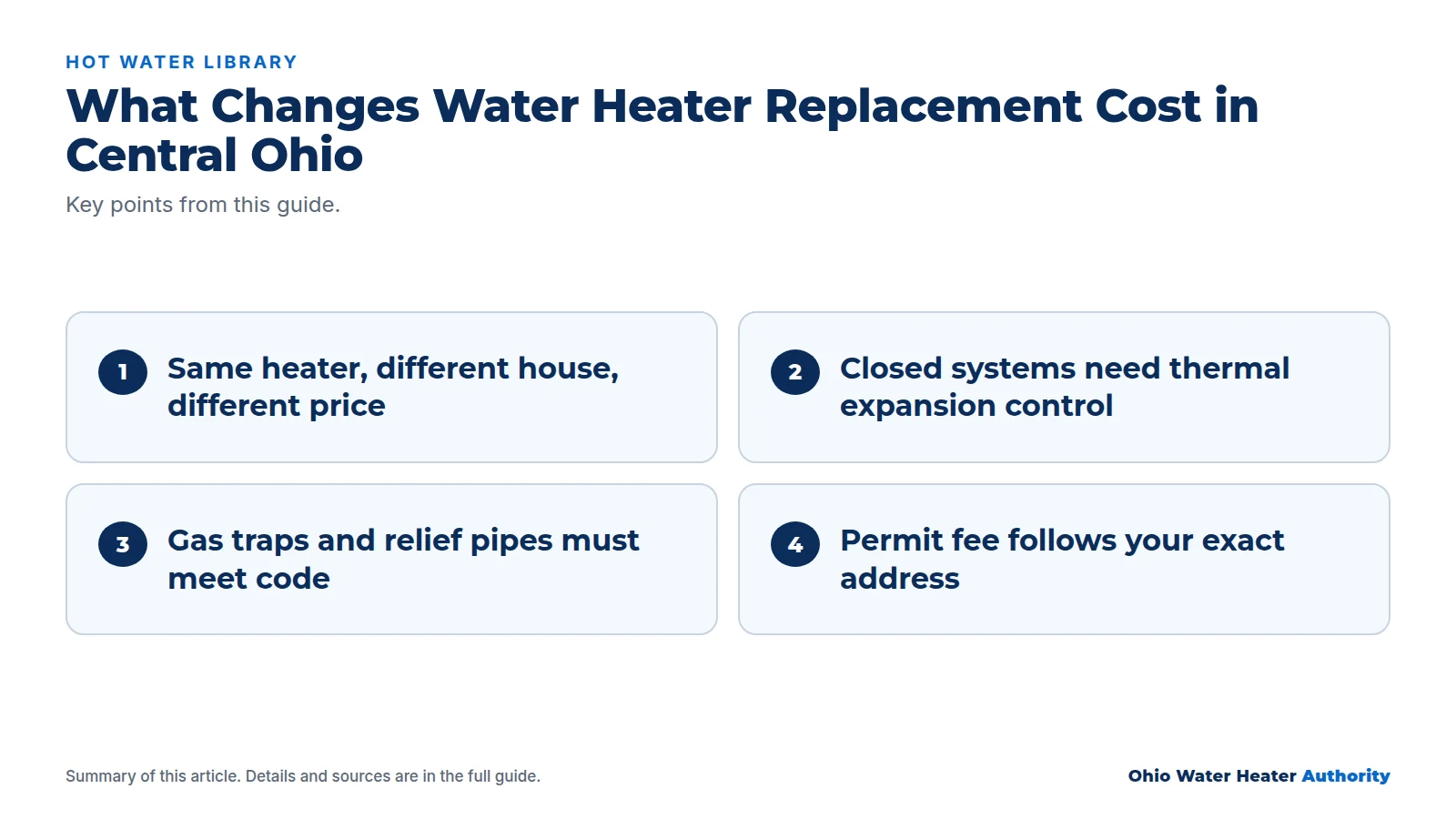
What a starting price assumes
Every starting-at price on our pricing page includes the unit, standard installation, the permit passed through at cost, haul-away of the old heater and startup testing. Standard assumes four things:
- The new heater goes where the old one was.
- It uses the same fuel and the same kind of vent.
- The water, gas and relief-valve connections already meet the current code and the new heater’s installation manual.
- The route in and out of the space does not add real time.
When all four hold, the starting price and the final estimate are usually close. When one does not, the job needs something the starting price could not see. Every OWHA price below is current published pricing, stated as an installed price or a fixed fee. Permit fees are set by each authority.
Code corrections the old installation may be missing
A heater that worked for twelve years was not necessarily installed to today’s requirements. A replacement is checked against the current code and the new heater’s manual, so these items appear even on a like-for-like swap.
Thermal expansion control on a closed system
A pressure-reducing valve, check valve or backflow preventer on your main water line makes the plumbing a closed system. Heated water expands, and in a closed system pressure rises every time the heater runs. Gas water heater installation instructions state that the heater must not be operated in a closed system without a provision for controlling thermal expansion. The usual provision is a thermal expansion tank. It is included in the Preferred and Authority tiers and costs $249 installed on an Essential job, or $299 for the larger tank used with 75-gallon heaters and higher static pressure. Our expansion tank guide covers sizing.
The gas connection
The installation manual for a typical atmospheric gas heater calls for a sediment trap, also called a drip leg, at least 3 inches long and as close to the gas valve as possible. Many older connections have no trap, and a new connector is part of every replacement. When the existing piping needs rework to reach the new valve, the standard gas line modification is $349. A tankless or high-recovery heater may also need larger gas piping, because it needs more gas input than a standard tank. That upsize is quoted after the line is sized on site.
The relief-valve discharge pipe
The temperature and pressure relief valve is the heater’s last safety device. Its discharge pipe must let the valve drain completely, end within 6 inches above the floor or anywhere below it, stay clear of freezing and blockage, and never be threaded, plugged or capped at the end. Older pipes are sometimes missing, short, routed uphill or capped. Correcting one is $189, and it is never optional.
A drain pan where a leak would cause damage
Under the Ohio Plumbing Code, a tank water heater installed where leakage will cause damage must sit in a pan of galvanized steel, aluminum, plastic or another approved material, and a plastic pan under a gas heater must meet flame-spread and smoke limits. The heater manual adds that the pan should be at least 4 inches wider than the heater and piped to an adequate drain. In a closet, on an upper floor or above a finished ceiling, a leak would usually cause damage, so the pan is typically required. In an unfinished basement beside a floor drain, it is often recommended instead, and the inspector decides. A pan with drain connection is $129 and is included in the Authority tier.
Where the heater sits
Location decides how much air, protection and labor the installation needs.

Closets and combustion air
A gas burner needs air. The heater manual treats a space as confined when it has less than 50 cubic feet of room volume for every 1,000 BTU per hour of input from all gas appliances in that space. By that rule, a heater rated at 40,000 BTU per hour needs 2,000 cubic feet on its own, and a furnace in the same closet raises the figure further. A confined space needs permanent openings, such as a louvered door or ducts to another room or outdoors, sized to the total input. Without enough air, combustion products can recirculate into the room. Corrections are quoted on site.
Garages
Gas heaters in residential garages must be installed or protected so a vehicle cannot damage them, and the manual warns against locations where gasoline or other flammable vapors are likely unless ignition is prevented. Depending on the heater’s listing and the local inspector, the burner may also need to sit on an elevation stand, which is $199 when required.
Access
Narrow stairs, tight closets and long carries take longer. The difficult access charge of $149 applies only when access adds real time.
When the new heater is a different kind
Changing type changes the systems around the heater, not just the heater.
- Atmospheric to power vent or tankless. These use plastic vent pipe instead of a metal flue. A new vent run is $299 per 10 feet.
- Staying atmospheric. The metal vent connector must be sound so combustion gases do not spill into the room. A damaged connector is replaced for $249.
- Gas tank to tankless. Condensing units produce acidic condensate. A neutralizer is $149, and some jurisdictions require one.
- Any heater to a hybrid heat pump. ENERGY STAR installation guidance notes that most 240-volt models need about 700 cubic feet of surrounding air, though some need as little as 450, that a closet of at least 84 cubic feet can work with a fully louvered door, and that the panel should be ready for a 240-volt, 30-amp circuit. Condensate must reach a drain or a $229 pump. Electrical is a separate licensed trade in Ohio, so we coordinate a licensed electrician for $149 plus the electrician’s price passed through.
The permit depends on your address
We pull the permit wherever the jurisdiction requires one and pass the fee through at cost. The fee follows whoever has authority over your exact address, which is not always the city on your mail. Fees are set by each authority and change from year to year. Two examples from published 2026 schedules: the City of Columbus lists water heater replacement as minor work with a $140 permit that includes one inspection, and the City of Dublin charges a $135 administrative fee plus $20 per fixture. In Columbus, plumbing permits and inspections are handled by the city’s Building and Zoning Services. The authority is confirmed for your exact address at booking, and the quote adjusts either way.
What you can check before the visit
You can spot most of these in a few minutes without touching anything.
| What to look at | What it can mean for the quote | Status |
|---|---|---|
| A valve or regulator on the main water line near the meter | Closed system, so thermal expansion control is needed | Required |
| No short capped pipe pointing down where the gas line meets the heater | Sediment trap likely missing | Required |
| A relief-valve pipe that is missing, ends high above the floor, runs uphill or is capped | Discharge correction needed | Required |
| A heater in a closet, on an upper floor or above finished space | Drain pan needed | Required |
| A heater and furnace sharing a small closet with a solid door | Combustion air may be short | Verify on site |
| A gas heater in a garage | Impact protection or an elevation stand may be needed | Verify on site |
| Narrow stairs, tight turns or a long carry | Difficult access charge possible | Verify on site |
| A planned switch to a hybrid heat pump | Circuit, air space and condensate drain to confirm | Verify on site |
Look, do not adjust. Every check above is visual. Do not remove burner or element covers, turn the gas control or touch wiring. If you smell gas, leave the house without operating switches or lights, and call your gas utility or 911 from outside.
How the on-site estimate handles these items
The technician works through the conditions above. Anything beyond the starting price is added from the published price list, labeled required, recommended or optional. Nothing is added without your approval. Some items already sit inside a tier. Preferred includes the expansion tank and, on tankless, the isolation valve kit. Authority adds the drain pan, a leak sensor with automatic shutoff and the first year of the maintenance plan. If your home needs those items anyway, compare tiers with them counted.
Work is performed by appropriately licensed personnel or partners. Sales made at your home carry a three-business-day right to cancel under the Ohio Home Solicitation Sales Act, and we honor it. Our installation page walks through the visit.
What to do next
Start with the quote builder to see the starting-at installed price for the heater and tier that fit your home. Photos of the main water line, gas connection and relief-valve pipe help. Or call 844-792-8374, answered 24/7.

Common questions
Why is my estimated installed price higher than the online starting price?
The starting price assumes a standard swap in the same location, with the same fuel and vent type and connections that already meet code. When the technician finds a condition outside that, such as a closed system without an expansion tank or a capped relief-valve pipe, the item is added from the published price list. Each addition is explained and needs your approval before work continues.
My old water heater never had an expansion tank. Why does the new one need one?
Manufacturer instructions say a heater must not run in a closed system without thermal expansion control, and the replacement is checked against current requirements. If a pressure-reducing valve, check valve or backflow preventer was added to your main after the old heater went in, the need may be newer than the heater. The expansion tank protects the tank, the relief valve and your fixtures from repeated pressure spikes.
Is a drain pan required for water heaters in Ohio?
The Ohio Plumbing Code requires a pan where leakage from the tank will cause damage, which covers most closets, upper floors and heaters above finished space. In an unfinished basement beside a floor drain it is often a recommendation instead. The local inspector makes the final call for your installation.
Does the permit fee change the installed price?
It can. The fee is passed through at cost and is set by whichever authority has jurisdiction over your exact address. For example, the City of Columbus lists a $140 minor work permit for a water heater replacement in its 2026 schedule. We confirm the authority and its current fee at booking and adjust the quote in either direction.
Why does switching to a hybrid heat pump add more than the difference in heater price?
A hybrid usually needs a 240-volt circuit, enough surrounding air and a drain or pump for its condensate. The circuit is electrical work by a licensed electrician, coordinated for $149 plus the electrician’s price. Those items are priced once the space and the electrical panel have been seen.
Can I lower the price by skipping a required item?
No. Required items come from the code or the heater’s installation manual, and the permit inspection checks the installation against them. You can choose among recommended and optional items, such as a leak sensor or a ball-valve shutoff, and each is priced separately.
Sources
- Rule 4101:3-5-01, Water heaters (Ohio Plumbing Code, Chapter 5), effective October 15, 2025
- Installation and Operation Instruction Manual: Gas-Fired Water Heater with Flammable Vapor Ignition Resistant System
- Best Practices: Installing Heat Pump Water Heaters (HPWH Installation Guide)
- Plumbing Inspections
- 2026 Combined Development Related Fee Schedule
- 2026 Residential Fees Schedule