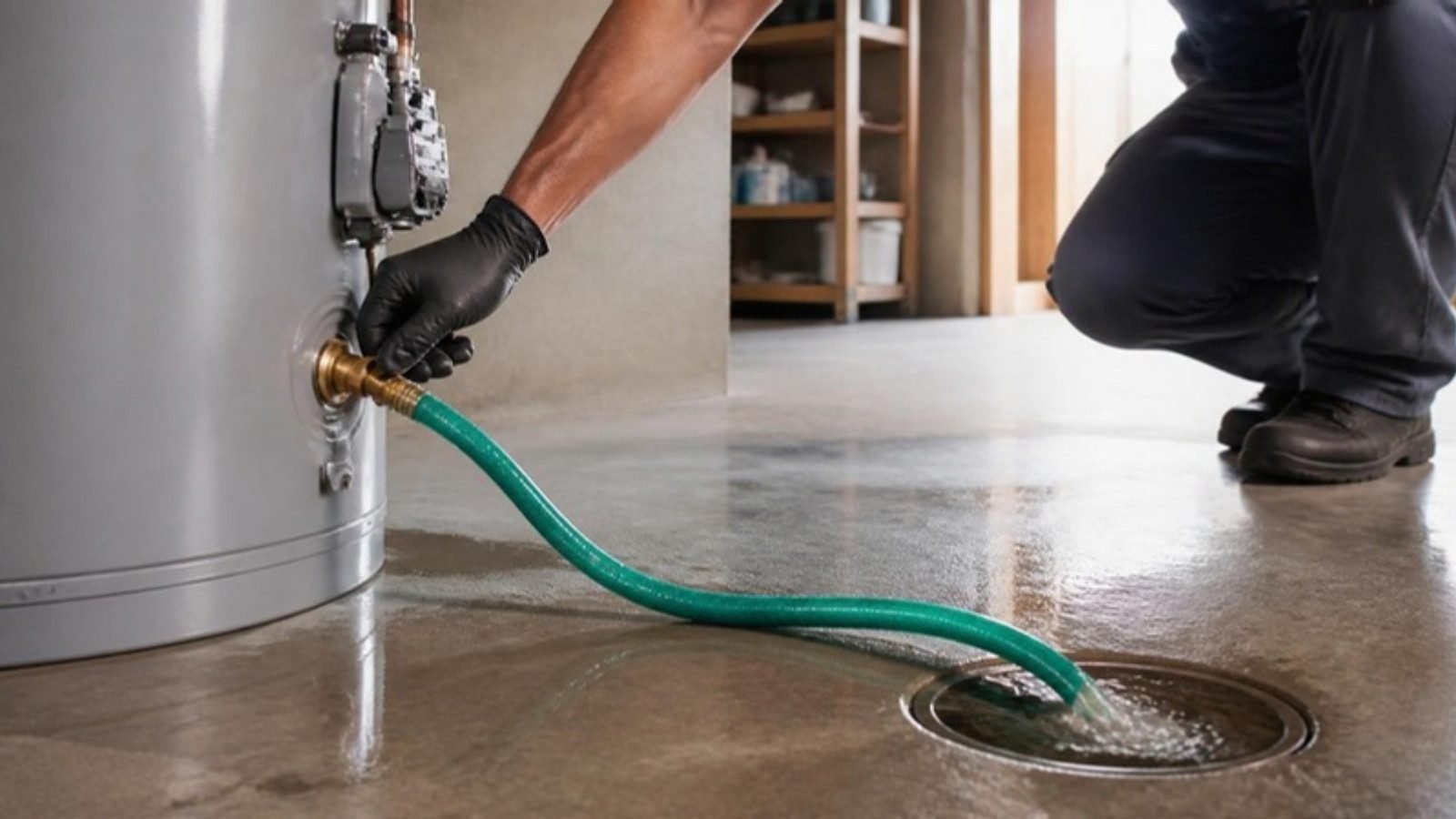
A water heater is the only appliance in most houses that runs every day for a decade with no attention at all. It tolerates that better than it should, which is why people assume it needs nothing. In Central Ohio’s moderately hard to hard water it does need something: one visit a year, either yours or ours, to remove sediment, test the safety valve and check the parts that fail quietly. The Department of Energy puts a tank’s life at 10 to 15 years; maintenance is most of the difference between the two ends of that range. This guide gives the annual checklist, the flush procedure step by step with the safety points that matter, what the T&P valve needs, the anode and expansion tank checks, what to leave to a technician, and what our maintenance plan covers.
The annual checklist
| Task | Tank (gas or electric) | Tankless | Hybrid heat pump | Who |
|---|---|---|---|---|
| Flush sediment / descale heat exchanger | Annually | Annually (descale) | Annually | Homeowner or technician |
| Test T&P relief valve | Annually | Annually | Annually | Technician, or homeowner only as the manual directs |
| Inspect anode rod | Every 3 to 5 years; 3 with a softener | Not applicable | Every 3 to 5 years | Technician |
| Check expansion tank charge | Annually | Annually | Annually | Homeowner (tap test) or technician (gauge) |
| Measure static water pressure | Annually | Annually | Annually | Homeowner |
| Inspect venting and draft | Annually (gas) | Annually | Not applicable | Technician |
| Clean air filter | Not applicable | Inlet screen annually | Every 3 months or per indicator | Homeowner |
| Check condensate drain and neutralizer | Not applicable | Annually | Annually | Homeowner or technician |
| Check for leaks at fittings, drain valve, pan | Quarterly glance | Quarterly glance | Quarterly glance | Homeowner |
| Verify setpoint at a tap with a thermometer | Annually | Annually | Annually | Homeowner |
How to flush a tank water heater
Flushing drains water from the bottom of the tank, carrying sediment with it. On a tank that has been flushed regularly it takes twenty minutes. Follow the draining instructions in your heater’s manual; the steps below are the general order. On a tank that has never been flushed, read the callout first.
Read before you flush. Water in the tank is hot enough to scald and a drain hose can whip when the valve opens. Do not flush a tank that has never been flushed and is more than about eight years old: disturbing a thick sediment layer can open a leak in a tank that was holding only because the sediment was plugging it. Never run an electric heater’s elements or a gas burner with the tank partly empty. If the drain valve is plastic and stiff, it can snap; stop and call rather than force it.
Turn off the heat
Gas: turn the gas control to OFF or VACATION, as the label on your heater directs. Electric: switch off the breaker. Elements exposed to air burn out in seconds.
Close the cold supply
The valve on the cold pipe above the heater. Confirm it closed by opening a hot tap; the flow should stop.
Connect a hose to the drain valve
Run it to a floor drain or outside, downhill. The water will be hot enough to scald, so keep the hose end where it cannot reach anyone and keep your hands clear of the valve and the discharge.
Open a hot tap upstairs
This lets air in so the tank can drain. Leave it open.
Open the drain valve
Let the tank drain until the water runs clear. A few gallons is enough on a maintained tank; a full drain is needed if the water is heavily discolored.
Stir the sediment
With the drain still open, briefly open the cold supply for a few seconds to swirl the bottom, then let it drain again. Repeat until the discharge is clear.
Close the drain and refill
Close the drain valve, remove the hose, open the cold supply. Watch the open hot tap; when water flows steadily with no sputtering, the tank is full and the air is out.
Restore heat
Only after the tank is full. Gas: return the control to its setting, or relight by following the lighting instructions on the label exactly if you turned it to OFF, and confirm the burner lights. If it will not light after one attempt, turn it to OFF and call. Electric: switch the breaker on. Check the drain valve for drips over the next hour.
A tankless unit is descaled rather than flushed; the descaling guide covers that procedure and the isolation valves it needs.
Testing the T&P relief valve
The temperature and pressure relief valve is the safety device that keeps a tank from becoming dangerous if the thermostat fails. It sits on the top or upper side of the tank with a lever and a discharge pipe running down toward the floor. Test it only as your heater’s manual directs, and many homeowners leave the test to the annual service visit. The reason is practical: a valve that has not opened in years may not reseat after it is lifted, and it can keep dripping scalding water until it is replaced. A technician tests it with the replacement valve on hand and confirms it opens and reseats. What you can do is look: water or mineral crust at the end of the discharge pipe is a sign to call. If the discharge pipe is missing, capped, reduced or runs uphill, that is a code correction we make at $189.
Checking the anode rod
The anode is inspected rather than tested. It requires draining a few gallons, breaking the rod free with a large socket and pulling it, which needs overhead clearance and often more force than a homeowner wants to apply to the top of a tank. We do this as anode service at $249, or as part of the maintenance plan when it is due. Every three to five years on municipal water, three with a softener. The anode rod guide explains what the rod looks like at each stage and when replacement no longer pays.
Checking the expansion tank
Tap it. Hollow at the top and solid at the bottom is normal. Solid all the way up means it is waterlogged and needs replacement. With a tire gauge on the air valve and the water side isolated and depressurized, the reading should match your static water pressure; if water comes out of the air valve, the diaphragm has failed. Watch the T&P discharge for drips after the heater runs, which is the usual symptom of a failed expansion tank. Replacement is $249 for the two-gallon size, and the expansion tank guide covers pre-charge and sizing.
Pressure, temperature and a quick look
- Put a gauge on a hose bib once a year. Under 80 psi static, and no big jump while the heater runs. The water pressure guide explains the readings.
- Run the nearest hot tap for a minute and check it with a thermometer. 120°F is the usual target; if you store hotter behind a mixing valve, confirm the valve is still delivering 120°F.
- Look at the flex connectors, the drain valve, the pan and the floor. Mineral crust at a fitting is a leak that has been evaporating.
- On a hybrid, clean or replace the air filter as the indicator asks and confirm the condensate line drains.
- On a gas atmospheric heater, look at the draft hood and vent connector for rust, soot or gaps. Soot or a scorched jacket top means a combustion problem; stop using it and call.
What to leave to a technician
- Anode rod removal and replacement.
- Gas burner cleaning, gas pressure checks, thermocouple and gas valve work, and anything involving combustion or venting.
- Electric element and thermostat replacement, which involves 240V circuits.
- T&P valve replacement and any correction to its discharge piping.
- Expansion tank replacement and pre-charge setting.
- Tankless burner, fan, flow sensor and vent work, and the first descale on a unit with no isolation valves.
- Any flush on a neglected tank past eight years, where the right call may be not to flush at all.
The maintenance plan
The annual maintenance plan is $189 a year. It covers one scheduled visit: a flush or descale, the T&P test, expansion tank and pressure check, anode inspection when due, venting and combustion inspection on gas units, a temperature check at a tap, and a look at everything in the list above, with priority scheduling if something goes wrong between visits. The Authority tier includes the first year. It keeps the manufacturer’s warranty in good standing where annual service is a condition, and it means the parts that fail quietly get seen before they fail loudly. A standalone flush is $189 and a standalone descale is $299. Book on the maintenance page. If the heater is past its expected life, maintenance becomes a bridge rather than a plan; the repair or replace page, the size calculator and the quote builder are the next steps, and the gas and electric pages show what a new one includes.

One visit a year
The maintenance plan is $189 and covers flush or descale, safety checks and priority scheduling. Book a two-hour window or call 844-792-8374, answered 24/7.

Common questions
How often should a water heater be flushed?
Once a year in Central Ohio’s moderately hard to hard water. Homes with a softener can stretch it, and homes on very hard well water should not. A tank that has been flushed regularly takes about twenty minutes; the first flush on a neglected tank takes longer and, past about eight years, may be better skipped.
Is it safe to flush an old water heater?
Not always. On a tank over about eight years old that has never been flushed, a thick sediment layer may be plugging small corrosion spots, and stirring it can open a leak. We look at the tank’s age and condition first, and we will tell you when the right call is to leave it and plan the replacement.
How do I test the T&P valve?
Only as your heater’s manual directs, and many homeowners leave it to the annual service visit. A valve that has not opened in years may not reseat after the lever is lifted and can keep dripping hot water until it is replaced, so a technician tests it with a replacement on hand. Between visits, look for water or mineral crust at the end of the discharge pipe and call if you see it.
What does the maintenance plan include?
One scheduled visit a year: flush or descale, T&P test, expansion tank and pressure check, anode inspection when due, venting and combustion inspection on gas units, a temperature check, and priority scheduling between visits. It is $189 a year and the Authority tier includes the first year.
Does maintenance really extend a water heater's life?
Yes. Sediment overheats the tank bottom and buries electric elements; a spent anode leaves the steel unprotected; a failed expansion tank cycles pressure spikes through the tank. Each is caught by the annual visit. The Department of Energy’s 10 to 15 year range for tanks is wide because maintenance is most of the difference.
Can I do water heater maintenance myself?
The flush (following your manual, with the gas control at OFF or VACATION per the label or the breaker off, and care around scalding water), the expansion tank tap test, the pressure reading and the temperature check are homeowner tasks with normal care. Test the T&P valve only as the manual directs; many homeowners leave it to the annual visit. Anode replacement, anything involving gas, combustion or venting, 240V electrical work and T&P valve replacement belong to a technician.
What maintenance does a tankless water heater need?
An annual descale of the heat exchanger, cleaning of the inlet filter screen, a check of the condensate drain and neutralizer, and inspection of the venting and burner. Isolation valves make the descale a 45-minute job. The service is $299 standalone or part of the maintenance plan.