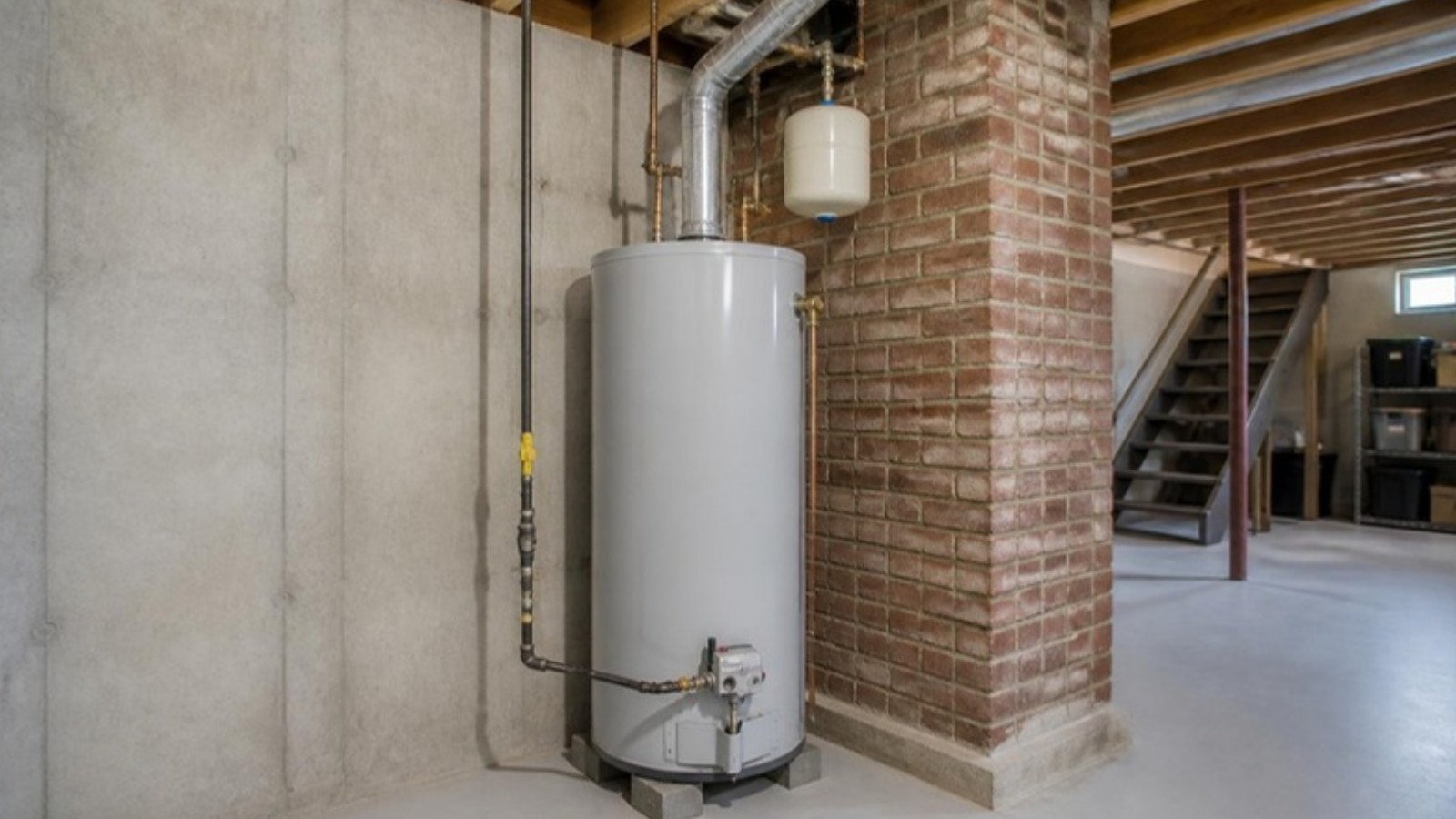
Replacing a gas water heater in Westerville is mostly a matching exercise. The new unit has to fit the same vent, the same gas supply, the same floor space and the same code requirements that apply at your address. Our gas water heater overview explains how atmospheric tanks work and what the installed tiers include. This article does something narrower. It gives you the questions to ask any installer before you approve a replacement in Westerville, and tells you what a clear answer should contain.
Westerville basics: permit, service window and ZIP codes
The local facts shape the schedule and the paperwork.
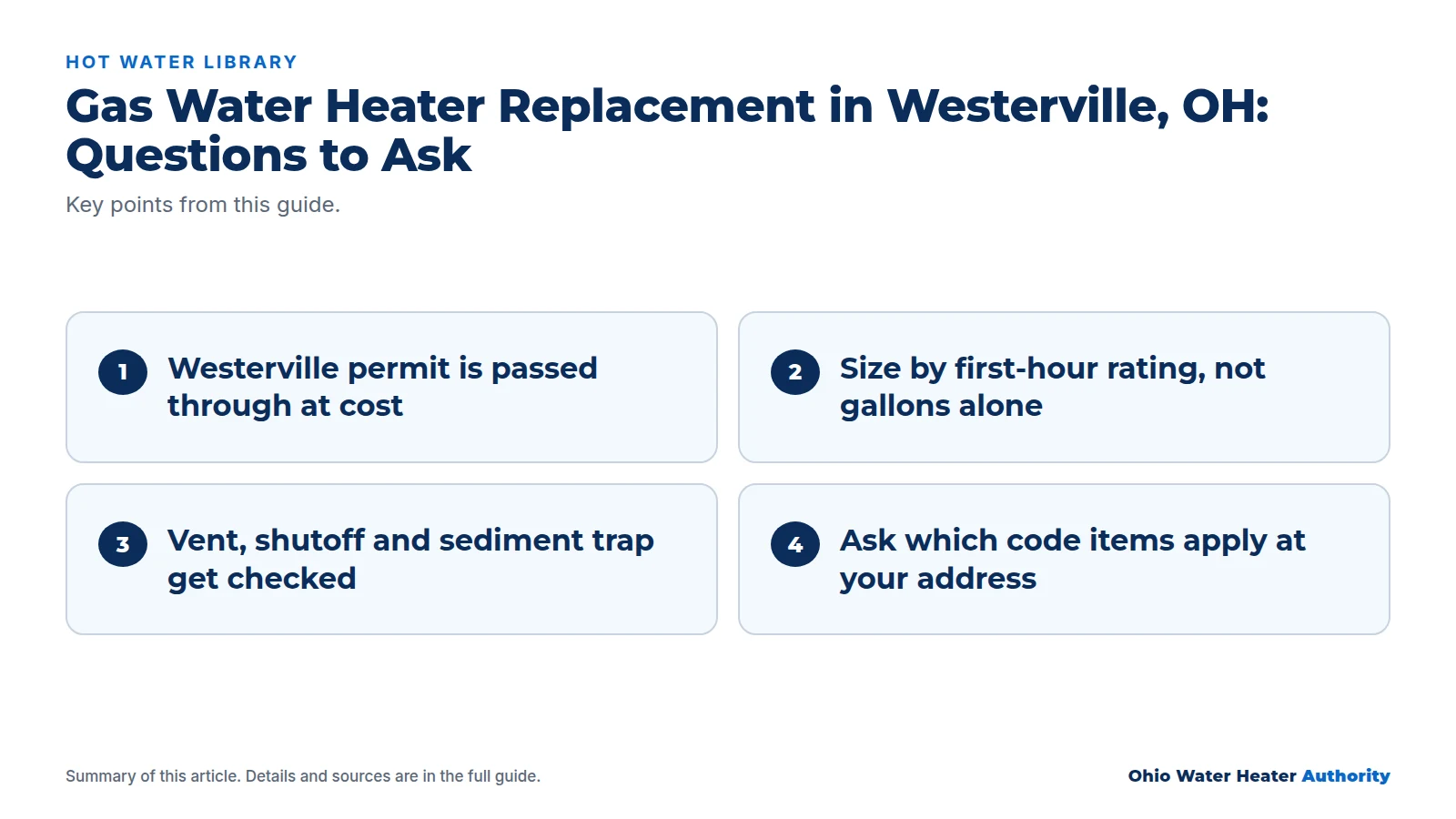
- Permit authority: City of Westerville Planning and Development. The permit fee is passed through at cost with no markup. The permit authority is confirmed for your exact address at booking, since township pockets near the city line can fall under a different office.
- Service window: Inner-suburb service ring: same-day two-hour windows when booked before 1 pm, otherwise the next available window; no distance adjustment.
- ZIP codes served: 43081 and 43082. You can see how Westerville fits into the rest of our coverage on the service areas page.
A good first question for any installer is simply, “Who pulls the permit, and is the fee in the price you just gave me?” If the answer is vague, the rest of the quote may be too.
Questions about the heater you are buying
Is this a like-for-like swap, or are you changing the size or type?
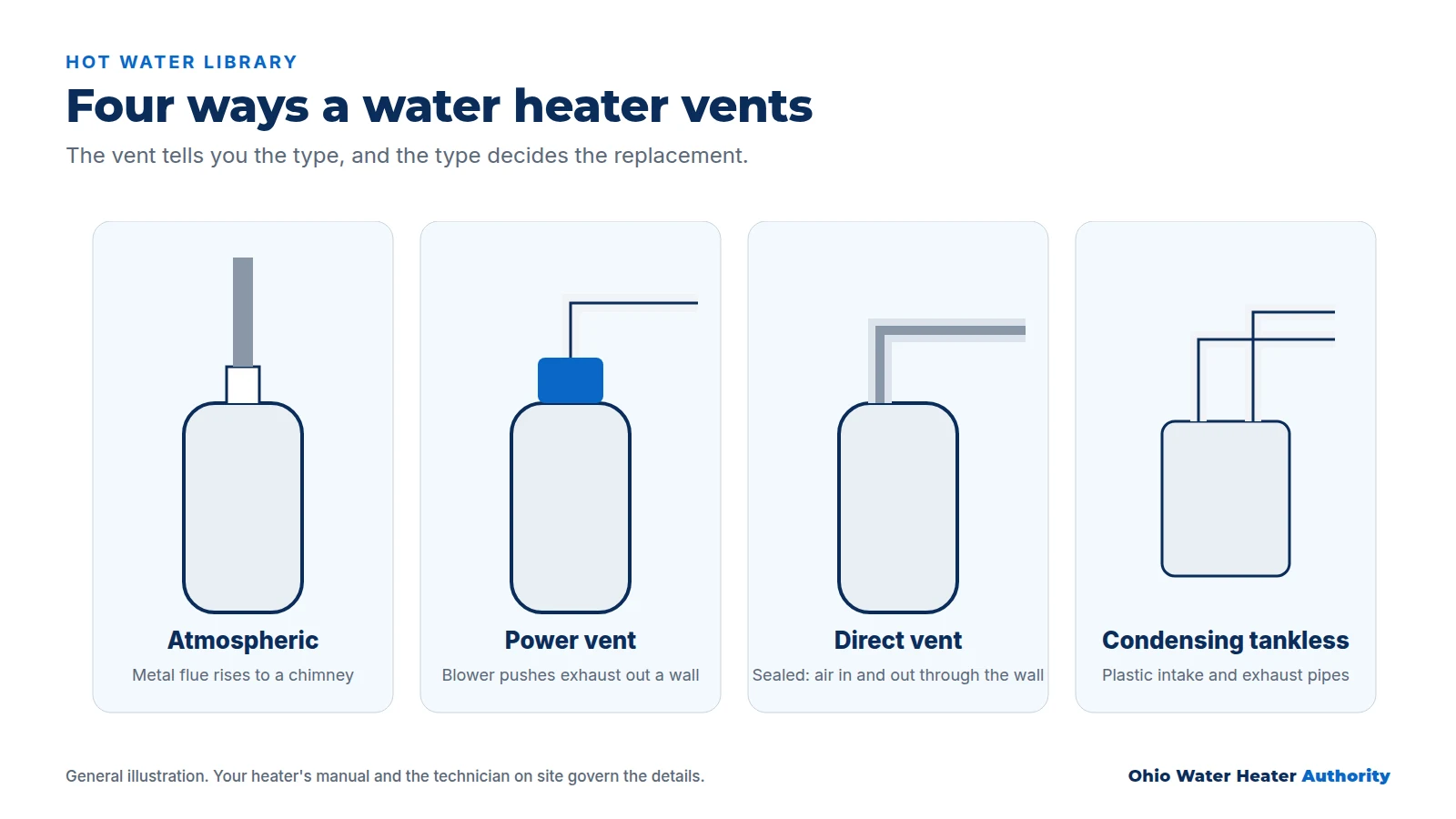
Many gas replacements are standard atmospheric tanks that vent through a metal flue into a chimney or B-vent. Changing to a power vent, direct vent or tankless unit changes the vent, the gas demand and sometimes the electrical needs, so the price and the timeline change with it. If you are not sure what you have now, our guide to identifying a gas, electric or power vent heater walks through the clues. If you are weighing electric instead, our guide to switching water heater fuels explains what that changeover requires. Ask the installer to say plainly which of these you are getting.
How was the size chosen?
Tank gallons alone do not tell you how much hot water you get in a busy hour. The better number is the first-hour rating, which ENERGY STAR defines as the estimated hot water a fully heated storage heater can deliver in one hour, measured at a 125°F outlet temperature. We size by peak-hour demand. A household of four with two baths typically lands on a 50-gallon gas tank, while five or more people or a soaking tub points toward a 75-gallon high-recovery model or another option.
What does the warranty actually cover?
There are two warranties, and they are easy to confuse. The tank warranty comes from the manufacturer. Our workmanship warranty covers the installation: 1 year on Essential, 2 years on Preferred and 5 years on Authority. Ask any installer to put both in writing, separately.
Questions about venting and the gas line
Here the manufacturer’s installation instructions set the rules. The points below come from a current atmospheric gas installation manual, not from preference.
- Will the vent be checked, not just reconnected? The manual we reviewed requires the draft hood supplied with the new heater, a clear chimney passage before connection, and it warns against sharing a vent with a power-vented appliance. Exhaust fans and dryers can reverse the draft, so the draft should be checked after startup.
- Does the gas connection get new parts? Expect a readily accessible manual shutoff valve, a sediment trap (drip leg) of at least three inches, a new approved connector and a leak test of every joint.
- Is there enough combustion air? A heater in a small closet needs openings near the top and bottom of the enclosure or air ducted from outdoors. A finished basement sometimes encloses a heater that once sat in open space, so this is worth asking about directly.
- If the heater is in a garage, will it be protected or raised? A gas heater in a garage must be protected from vehicles, and depending on its listing and the inspector it may need an elevation stand that puts its ignition source 18 inches above the floor.
If you smell gas. Leave the house first. Do not operate switches, lights or appliances on the way out. Call your gas utility or 911 from outside or from a neighbor’s home, and do not go back in until they say it is safe. A replacement quote can wait.
Questions about code items that often surface on replacement
Some items are required once a permit is involved. Others are recommended because of where the heater sits. Knowing which is which keeps you from paying for extras you do not need.
| Item | When it applies | What to ask |
|---|---|---|
| Thermal expansion tank | Required on a closed system, meaning a pressure-reducing valve, check valve or backflow preventer on the main | “Did you check for a PRV or check valve on my main?” |
| Drain pan | Required by Ohio rule where a tank leak will cause damage; Recommended anywhere finishes are nearby | “Where will the pan drain, and is the pan material rated for a gas heater?” |
| T&P discharge pipe | Required on every tank; must run full size, downward, to an approved termination, never capped | “Will the existing discharge pipe be corrected if it is wrong?” |
| Garage elevation stand | Verify for gas heaters in garages, depending on the heater’s listing and the inspector | “Is the stand included in this price?” |
| Full-port ball valve shutoff | Optional, useful where an old gate valve is stiff or leaks | “Is the cold supply valve being replaced or reused?” |
On drain pans, Ohio’s current water heater rule (Ohio Adm.Code 4101:3-5-01, effective October 15, 2025) requires a pan wherever tank leakage would cause damage, and it sets a fire-performance standard for plastic pans placed under gas-fired heaters. Our guides to drain pans and expansion tanks explain each in more depth.
Questions about price, paperwork and who does the work
- Is the price installed, and what is in it? Our installed prices include the unit, standard installation, the permit at cost, haul-away of the old heater and startup testing. Current published pricing for a 50-gallon atmospheric gas tank starts at $1,949 (Essential), and a 40-gallon starts at $1,849 (Essential). The estimated installed price is confirmed once conditions at your home are known, and nothing is added without your approval.
- Who performs the work? Ohio’s contractor licensing law names plumbing and HVAC among the trades the Ohio Construction Industry Licensing Board licenses. Our work is performed by appropriately licensed personnel or partners. Ask any installer the same question and expect a direct answer.
- What if you agree to the job at your kitchen table? Ohio’s Home Solicitation Sales Act gives you three business days to cancel a sale made at your home. We honor it.
What you can check before anyone arrives
These visual checks make the quote more accurate. None require tools or touching the burner area.
- Photograph the rating plate on the side of the tank. It lists the model, serial number and the gas the heater is built for.
- Find the gas shutoff on the line feeding the heater and the cold water shutoff above it.
- Look at where the metal vent pipe leaves the top of the heater and where it enters the chimney or wall. Note any gaps, rust or loose sections, but do not adjust them.
- Move paint, gasoline and solvents away from the heater area. The manufacturer instructions are clear that flammable vapors and gas appliances do not belong in the same space.
- Measure the height and width of the space, including any door opening the new tank must pass through.
What to do next
If you are in 43081 or 43082 and want a number before anyone visits, build your system and see the starting-at installed price on our quote page. You can also call 844-792-8374, answered 24/7, and we will confirm the permit authority for your address when you book.

Common questions
Do I need a permit to replace a gas water heater in Westerville?
Replacements are permitted through the City of Westerville Building Division, part of Planning and Development. We pull the permit for you and pass the city fee through at cost. Because some addresses near the city line sit in township pockets, we confirm the permit authority for your exact address at booking.
Can you replace my water heater the same day in Westerville?
Westerville is in our inner-suburb service ring. That means same-day two-hour windows when you book before 1 pm, otherwise the next available window, with no distance adjustment.
Should I replace my gas water heater with the same size?
Often, but not automatically. The right size depends on how much hot water your household uses in its busiest hour, which is why the first-hour rating matters more than tank gallons. If your household or fixtures have changed since the old heater went in, it is worth rechecking.
Why would a replacement quote include an expansion tank?
If your water main has a pressure-reducing valve, check valve or backflow preventer, the system is closed and heated water has nowhere to expand. An expansion tank absorbs that pressure and is required on closed systems. If your system is open, you should not be charged for one.
Is a drain pan required under a water heater in Ohio?
Ohio’s water heater rule requires a pan where leakage from the tank would cause damage, such as above finished space. Plastic pans under gas-fired heaters must meet a fire-performance rating. Where a leak would not damage anything, a pan is still a sensible precaution but may not be required.
Sources
- Rule 4101:3-5-01 Water heaters (effective October 15, 2025)
- Section 4740.01 Contractor licensing definitions
- Water Heater Key Product Criteria
- High Efficiency Atmospheric Vent Gas Water Heater: Installation and Operation Manual
- Planning & Development: Forms and Applications (Building Permit Applications, Water Heater Replacement)